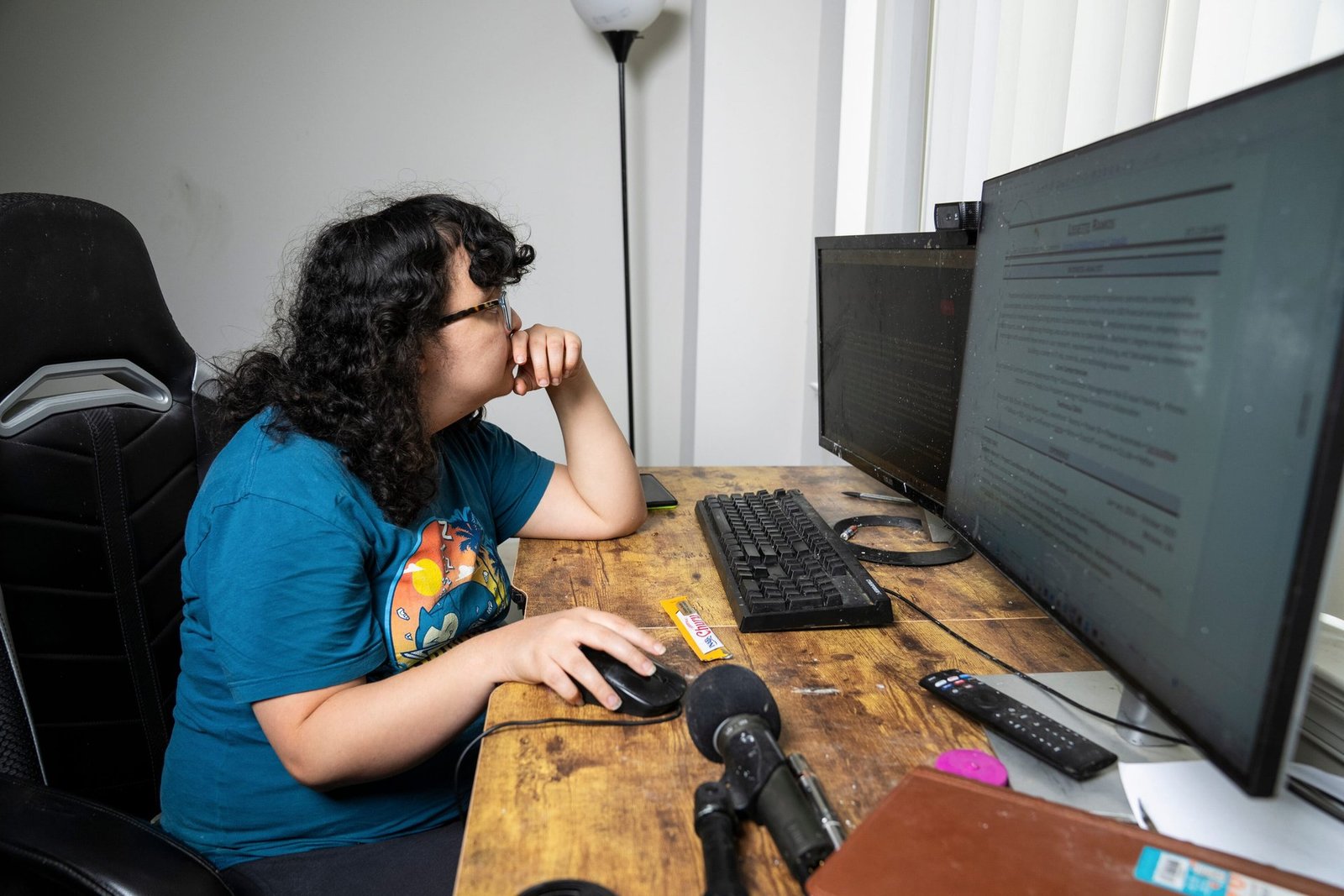
Matt Segel was considered one of 1000’s of faculty college students who utilized for an internship in fall 2022. He tried for, amongst different issues, a monetary analyst position with JPMorgan Chase.
The applying led to considered one of three interviews he took by way of the video and AI hiring platform HireVue.
“The primary one I obtained, I used to be fairly excited as a result of I believed it was an actual interview. I didn’t actually know concerning the HireVue factor,” Segel advised USA TODAY. “After which after that, I wasn’t excited to only form of discuss to no one.”
Monetary analyst internships like JPMorgan’s can obtain lots of of 1000’s of candidates every year. In 2025, 360,000 individuals utilized to 2,600 intern positions at Goldman Sachs — a 300% enhance from 2018, CEO David Solomon advised Fox Enterprise on the time. HireVue and related hiring platforms are sometimes used to assist recruiters deal with more and more massive applicant swimming pools.
Nonetheless, “it felt just a little bit bizarre,” Segel mentioned of the expertise.
“It’s powerful to actually get a gauge on somebody’s character, who they’re, simply via a video recording,” he added. He didn’t land any of the internships.
In response to a 2026 Greenhouse report on AI in hiring, 54% of candidates surveyed have been interviewed by an AI system as a part of a job software course of.
HireVue is utilized by over 60% of the highest 100 largest U.S. firms and eight of the ten largest U.S. federal businesses, a Stanford examine discovered this 12 months. The researchers additionally noticed proof of racial disparities in AI-based candidate screening, in response to the examine.
Federal employment discrimination legal guidelines are supposed to defend candidates when AI methods are used to discriminate by prohibiting the usage of screening exams, background checks or choice standards that disproportionately deny a protected group, in response to the Equal Employment Alternative Fee.
Kathleen Creel, a co-author of the Stanford examine and an affiliate professor on the College of Michigan, advised USA TODAY that one of many causes AI in hiring is harmful is because of algorithms making the identical errors again and again, or “algorithmic monoculture.”
However these algorithms, and the way in which they’re understood, could be difficult, even to the corporate utilizing them, in response to Emilio Castilla, MIT professor and creator of a ebook about expertise administration within the age of AI.
“The hazard is that AI could make biased selections seem goal, scientific, and subsequently more durable to query,” Castilla wrote to USA TODAY.
What Does the Know-how Do?
HireVue’s expertise is constructed on a third-party massive language mannequin and skilled on their very own analysis. It’s built-in into an organization’s applicant monitoring system to schedule and conduct interviews, in response to HireVue’s chief evangelist Dina Taylor.
Candidates can select to decide out of an AI-conducted interview, notifying the corporate to place them via a non-AI course of, however most candidates persist with the AI possibility, in response to Taylor. At one firm that makes use of HireVue, she mentioned that solely 4% of candidates opted out.
The questions posed within the AI interview are as much as the corporate — it may possibly vary from fundamental questions like age or eligibility to work in a sure nation to extra nuanced follow-up questions primarily based on responses. Evaluations of a candidate are primarily based solely on solutions given within the interview, Taylor added.
“It’s actually simply surfacing all the data primarily based on the candidate responses and providing you with extra details about how they did compared to the job necessities themselves,” she advised USA TODAY, including that the AI wouldn’t classify any solutions as “good” or “unhealthy.”
“It’s surfacing all the goodness as a way to make that call,” Taylor mentioned. A human recruiter at all times makes the ultimate resolution.
Counting on people to make the ultimate resolution isn’t sufficient to quell Castilla’s fears of biased algorithms, although. “In spite of everything, one of many causes organizations are turning to AI is that human decision-making itself could be biased!” he wrote.
HireVue works with nearly 1,000 firms the world over, in response to Taylor. The corporate was based in 2004 as a video interview platform and has since expanded into AI.
In September, Amazon launched Join Expertise, its personal AI hiring service. It was designed for high-volume hiring, like vacation jobs, retail and safety, in response to Kate Totaro, Join Expertise’s product lead.
Join Expertise was constructed from Amazon companies and knowledge, although it isn’t used for all of Amazon’s hiring. Much like HireVue, it acts as a plug-in to an applicant monitoring system to offer assessments and interviews. It’s blind to candidate resumes and different figuring out data.
“No names, no zip codes. All of the issues which are very generally associated to bias, the service has no visibility to by any means,” Totaro mentioned.
The software is made up of a sequence of AI fashions that standardize a job description and pull out “competencies” required for the job, then conduct assessments and interviews to determine whether or not a candidate has the talents required for a job, and write related behavioral questions.
The fashions embrace guardrails to stop testing irrelevant expertise, in response to Totaro, like testing for bodily power in a customer support position.
The recruiter solely sees a candidate’s evaluation scores, transcripts and AI summaries of the interview, however unattached to names.
Like Castilla, Creel is hesitant that these guardrails are sufficient as a result of she doubts that many recruiters are wanting on the candidates with decrease AI-generated scores.
“This human-in-the-loop factor is a part of how firms form of legally defend themselves,” she mentioned.
In response to the Greenhouse report, some employers agree together with her: simply 21% of recruiters and hiring managers mentioned they’re “very assured” that their methods aren’t filtering out certified candidates.
The ‘Paradox of Algorithmic Meritocracy’
When an AI system is skilled on previous hiring selections, it gained’t essentially be taught equity; it can be taught patterns that had been probably formed by flawed human assumptions, Castilla wrote. He calls this the “paradox of algorithmic meritocracy.”
“Organizations could find yourself utilizing refined new applied sciences to breed very outdated issues,” he wrote, referencing Amazon’s first try to create an AI hiring software in 2018.
The corporate scrapped the software after it was discovered to point out bias towards girls, and it was by no means rolled out past a trial foundation, in response to Amazon. That service was solely separate from Join Expertise, which was examined extensively round protected lessons to exclude protected identities from the analysis premise, Totaro mentioned.
HireVue, too, has handled discriminatory points. A 2019 investigation of HireVue’s speech recognition algorithms discovered it deprived non-white and deaf candidates when assessing candidates’ proficiency in talking English.
And in 2025, hiring software program utilized by HireVue resulted in systemic discrimination, violating the Colorado Anti-Discrimination Act, the Individuals with Disabilities Act and Title VII of the Civil Rights Act, in response to a lawsuit filed by the American Civil Liberties Union.
In response to the Greenhouse report, some candidates mistrust the software program. Thirty-five % of candidates surveyed mentioned AI has shifted bias from human prejudice to algorithmic filtering, and 18% consider AI amplifies bias as a result of it learns from historic patterns.
Castilla is uncertain that AI might ever be “completely meritocratic,” pointing to the way in which totally different firms may worth totally different qualities that an AI can’t account for.
“We must always consider not solely whether or not the algorithm predicts historic hiring selections, however whether or not it helps determine candidates who subsequently carry out nicely within the job,” he wrote.
He’s, nevertheless, hopeful concerning the alternative for change AI might convey if used in a different way.
“Essentially the most thrilling chance is just not merely that AI may assist us discover the perfect expertise extra effectively,” he wrote. “It’s that AI may assist us acknowledge expertise that our conventional hiring practices have systematically ignored.”
An AI ‘Suggestions Loop’
A part of the explanation firms flip to AI hiring software program is to sift via the volumes of candidates utilizing AI of their purposes.
A survey by LinkedIn discovered that 81% of individuals trying to find jobs in 2025 used AI to assist write resumes and canopy letters. In 2026, recruiters evaluate nearly 200 extra purposes than they did for a similar job in 2021, in response to a Expertise Traits report by the recruiting platform Ashby.
“It’s a very attention-grabbing suggestions loop the place it’s like AI is creating this surge and AI is creating extra noise, after which through the use of AI for good, you may assist work via the noise and higher perceive what your high quality expertise pool appears like,” Taylor mentioned.
However “effectivity in screening candidates is just not the identical as effectiveness in figuring out expertise,” Castilla wrote. “And neither essentially ensures equity.”
Greta Reich covers the bogus intelligence business for USA TODAY via a fellowship from the Tarbell Middle for AI Journalism. Funders don’t present editorial enter.
Reporting by Greta Reich, USA TODAY
Trending Merchandise